16 Days Of Activism 2025
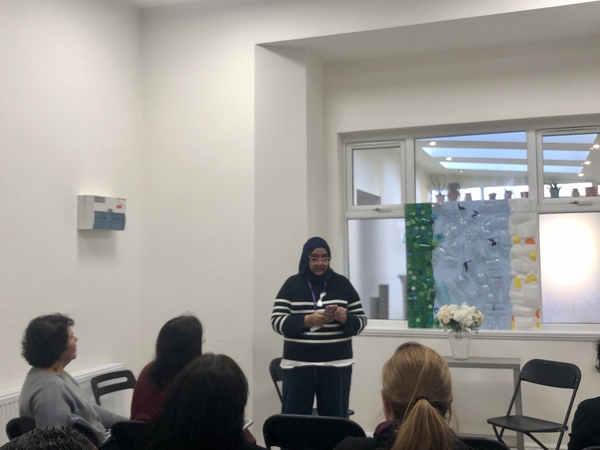
16 Days Of Activism Open Day
Wednesday 10th December 2025
AWRC marked the end of 16 Days of Activism 2025 with an Open Day, where we invited our stakeholders, members of the community interested in our work and other organisations working in the Violence Against Women and Girls (VAWG) sector to join us and learn more about our work.
We heard stories about the lived experiences of survivors from different ethnic backgrounds, shared by our caseworkers. We also heard moving poetic tributes from our Training Manager Aasifa and a powerful speech from our Contracts Manager Zarreen.
Not only did our Open Day mark the end of 2025's 16 Days Of Activism campaign, it was also Human Rights Day. Zarreen's speech captured the importance of taking an intersectional approach to human rights, and of listening to those whose lived experiences differ from our own. You can read the full text of the speech below:
"Everyday sexism — like catcalling, shaming comments, or so-called jokes — is often dismissed as harmless. But these behaviours are the roots from which abuse grows. They normalise disrespect, they set the tone for inequality, and they create the foundations in which harmful practices can flourish. When we allow small behaviours to slide, we create an environment where control and violence can thrive.
At AWRC, we see the impact of this every day. Survivors are silenced not only by perpetrators, but by communities and institutions that fail to recognise harmful practices. Honour-based abuse, forced marriage, dowry abuse, caste-based discrimination, faith-based coercion, and abandonment abroad — these are not cultural traditions. They are forms of gendered violence. Too often they are hidden within families and communities or minimised by professionals who feel uncomfortable naming them. But harmful practices must be recognised as abuse. Anything less puts survivors at risk.
For survivors with no recourse to public funds, the barriers are even greater. Perpetrators weaponise immigration status — confiscating passports, threatening deportation, or abandoning survivors abroad. When these survivors seek help, they are often excluded from housing, support and welfare due to their status. They are silenced by perpetrators and then silenced again by the state. We must speak up against this structural violence.
We must also speak up about racist misogyny. Across the UK, Black and Brown women are being targeted with sexual violence that is both racist and misogynist in nature. Just weeks ago in the West Midlands, a Sikh woman was racially targeted, violently raped, and left traumatised. This attack was intended not only to harm her, but to instil fear in an entire community. Racist sexual violence is not a historic issue — it is happening now. These attacks show us that race and gender cannot be separated; violence against women and girls is deeply shaped by racism, faith discrimination, and misogyny. We must name this and challenge it wherever it appears.
This is why the VAWG agenda must be intersectional. Black and minoritised survivors are often over-policed and under-protected. When we speak about Black and minoritised survivors being over-policed and under-protected, we are not talking about theory — we are talking about lived reality. A reality that has been shaped by generations of racism, distrust, and trauma between Black communities and policing institutions in this country, especially here in London with the Metropolitan Police.
For many Black survivors, calling the police is not simply a safeguarding decision — it is a moral dilemma, a racialised risk calculation, and in some cases, a life-or-death equation. Black survivors are carrying multiple truths at once: They may be experiencing violence and abuse. They may desperately want protection for themselves and their children. And at the same time, they may fear that reporting will harm rather than help the Black men in their community.
Because Black survivors know what happens to Black men once they enter the criminal justice system. They know about stop and search disparities. Disproportionate use of force. Over-criminalisation. Racial profiling, harsher sentencing, police brutality cases that never received justice, and the long history of mistrust rooted in lived experience, not imagination.
Black survivors have grown up seeing this. They have witnessed it in their families, in their schools, in their communities. They have carried the collective memory of these harms.
So, when abuse happens, their silence is not because they are not suffering. Their silence is because they know that reporting may expose Black men to a system that has consistently shown itself to be unsafe for them.
This means many Black survivors are not only protecting themselves — they are protecting their community from further state violence. Black survivors fear two harms at the same time: Firstly, Harm from the perpetrator and secondly harm from the state — if they report him. And too often, the state responds to BOTH badly.
Black survivors say: “I don’t want to be the reason he ends up in prison.” “I know what they will do to him.” “He will not be treated like other men.” “My children need a father, not a criminal record.” “The police won’t protect me — they will punish him.” This is not denial. This is not minimising abuse. This is survivors navigating racism while navigating violence.
While Black communities are over-policed in criminalisation, they are simultaneously under-policed in protection. Black survivors report not being believed, being dismissed, being stereotyped as “strong” and therefore “able to cope”, being viewed as “aggressive” when expressing fear or distress, slow or no response to calls, lack of safeguarding interventions, less likelihood of being referred to specialist services
This is compounded by harmful media narratives and racist assumptions that dehumanise Black women, portraying them as less vulnerable, less credible, or less deserving of care. The result? Black survivors face: more danger from perpetrators, more risk of losing children through social care systems, less access to justice, less access to safety
And they carry the enormous emotional burden of protecting the very men who harmed them — because they know the system is designed to harm those men even more.
This is exactly why survivor-centred, anti-racist practice is non-negotiable. We cannot tell Black survivors to "just call the police" without understanding the racialised consequences of that action. We cannot claim to be trauma-informed if we are not also race-informed. We cannot say we centre survivor voice if we ignore the fears survivors have about exposing their families and communities to state violence. Harmful practices are dismissed as cultural issues rather than recognised as serious forms of abuse. And NRPF policies leave survivors trapped with perpetrators. Without an anti-racist, survivor-centered VAWG response, the survivors most at risk will continue to be left behind.
So, we speak up for Black survivors whose silence has been misunderstood — when in reality, it has always been a form of protection, survival, and resistance. And we speak up: against domestic abuse, against harmful practices, against racism in policing, against systems that force survivors to choose between their own safety and their community’s safety
Survivors tell us repeatedly: ‘This is not my culture — it is abuse’, and ‘My silence nearly killed me’. We must center their voices in everything we do. Centring survivor voice is not a slogan. It is a responsibility. A duty. A commitment to being the voice of those who have been made invisible, ignored, dismissed, and silenced — sometimes for years, sometimes for a lifetime.
In the VAWG sector, especially for ‘by and for’ organisations like AWRC, we understand that the survivors who walk through our doors — especially those from Black and minoritised communities, those with NRPF, those experiencing harmful practices — come to us carrying fear, shame, stigma, and the weight of cultural, familial, community, and systemic pressures. Our role is to hold that fear, not add to it. Our role is to create safety, not suspicion. Our role is to amplify, not interrogate. Our role is to believe, not doubt. Our role is to restore power, not strip it away again.
Too many survivors tell us that the first harm was committed by the perpetrator — but the second harm was committed by the system. By professionals who used victim-blaming language. By services that made them feel judged for their choices. By institutions that asked why she didn’t leave rather than asking why he abused. By frontline responders who didn’t understand cultural barriers, immigration fear, racism, caste dynamics, or harmful practices.
When we centre survivor voice, we reject all forms of victim-blaming and replace them with dignity, patience, and humanity. We need to be the voice of: The invisible — the ones hidden in family networks, controlled through shame or honour-based expectations. The vulnerable — those with NRPF whose abusers weaponise immigration, leaving them silenced twice: by him and by the state. The scared — those who fear reporting will lead to community backlash, family punishment, or removal of their children. The unheard — those whose experiences fall outside mainstream narratives of domestic abuse.
Centring survivor voice means saying clearly: “You are not to blame.” “You are not alone.” “There is nothing you could have done to deserve this.” “Your safety, and your children’s safety, is our priority.” It means understanding that survivors may not disclose harmful practices or sexual violence immediately — not because they are being difficult, but because they are assessing whether the person in front of them is safe, culturally aware, and non-judgemental.
Many survivors tell us: “I needed to know you wouldn’t judge my culture.” “I needed to know you understood honour and shame.” “I needed to know I wouldn’t be criminalised for not leaving.” “I needed to know you could help me even though I have no recourse.”
Centring survivor voice means creating an environment where survivors don’t have to worry about being believed, blamed, or penalised. It means: Using language that empowers, not shames. Asking “What do you need?” rather than “Why didn’t you…?” Recognising the courage, it takes to speak against family, community, and culture. Understanding that for many survivors telling us their story is an act of resistance, survival, and liberation
And most importantly, it means ensuring that our responses — as practitioners, partners, councils, police, health, and safeguarding systems — reflect trauma-informed, culturally competent, anti-racist practice.
When survivors speak, we listen. When survivors hesitate, we wait. When survivors trust us, we honour that trust. When survivors break the silence, we make sure the world hears them.
Because centring survivor voice is not about giving survivors a seat at the table — it is about redesigning the table with them at the centre. Because survivors are not just telling us their stories. They are giving us an opportunity to build a safer London, and a safer world.
I now want to invite you to reflect: when did you last witness sexism, racism, or harmful practices being minimised or dismissed? Did you speak up? If survivors can take the risk of speaking out — often at enormous personal cost — then we must be brave enough to stand with them.
As we close, I want us to say this pledge together:
I will speak up when I see sexism.
I will speak up when harmful practices are minimised.
I will speak up against racist misogyny.
I will speak up for survivors with NRPF.
I will speak up until every woman and girl is safe, equal, and respected.
Together, we can build a London where survivors are believed, supported, and protected; where harmful practices are challenged; and where sexism and racism have no place. Together, we can build a safer London. "